
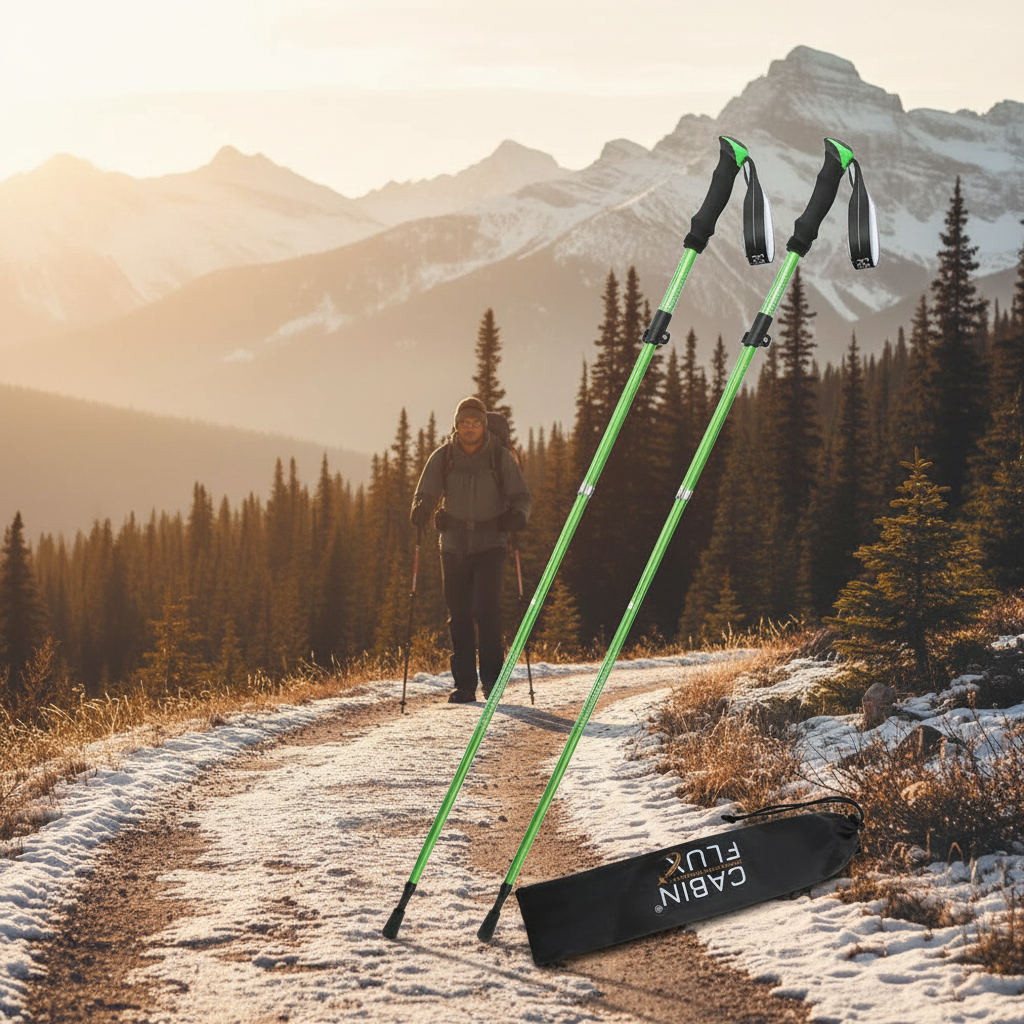
Nordic walking looks like an ordinary walk with poles — and that's exactly why people underrate it. Done properly, it turns a stroll into a full-body workout that's gentler on your joints than running and surprisingly addictive. Here's everything a beginner needs to start.
The technique came out of Finland, where off-season cross-country skiers kept training in summer by walking with their ski poles. It spread across Europe as a fitness activity in its own right, and today millions do it on trails, parks and city paths. All you need is a decent pair of poles and ten minutes to learn the rhythm.
What Nordic walking actually is
Ordinary trekking poles are mostly about balance — you plant them to steady yourself on rough ground. Nordic walking flips that idea. You actively push off the poles with each stride, driving yourself forward using your arms, shoulders, chest and back. Your legs still do their share, but now your upper body is working too. It's less "walking with support" and more "propelling yourself along the ground."
Why it's worth doing
- It works far more of you. By engaging the upper body, Nordic walking recruits a large share of your muscles — chest, arms, back and core on top of the legs.
- Harder effort, same perceived ease. You burn noticeably more energy than normal walking, yet it often doesn't feel harder, because the load is spread across your whole body.
- Easier on the joints. The poles take some load off your knees, hips and ankles, which makes it a kind option for anyone managing joint niggles or coming back from injury.
- Better posture and balance. The technique naturally opens your chest and straightens your spine, and the extra points of contact steady you on uneven ground.
It's the rare exercise that feels like a walk and works like a gym session.
Sizing your poles
Pole length matters more than anything else for a beginner. Too long or too short and the technique falls apart. The simple rule: stand upright with a pole planted by your foot and grip the handle — your elbow should sit at roughly a 90-degree angle, forearm parallel to the ground.
As a starting estimate, multiply your height in centimetres by 0.68. A 175 cm walker lands around 119 cm of pole. Adjustable poles let you fine-tune from there, which is why they suit most people — one pair works across different users and terrain.
The basic technique
- Walk naturally first. Let your arms swing in their normal opposition — right arm forward with the left leg, and vice versa. Nordic walking is built on that natural rhythm.
- Plant the pole angled back. The tip lands behind your leading foot, angled backwards, not straight down in front of you.
- Push, don't just plant. As you pass over the pole, press down and back through the handle to drive yourself forward. This push is the whole point.
- Open your hand at the back. As your arm swings behind you, relax and let your fingers open — the wrist strap keeps the pole with you. Then close and repeat.
It feels mechanical for the first few minutes, then clicks into a flow. Start on flat, even ground until the rhythm is automatic.
Trails vs city
The surface changes your setup. On soft trails, snow or mud, fit the wide baskets (discs) near the tip so the pole doesn't sink in, and use the sharp metal tips for grip. On tarmac, pavement and hard city paths, swap to the rubber pads that push over the metal tips — they grip better on hard surfaces, absorb shock, and are far quieter. Good poles come with both.
Folding travel poles: pack them anywhere
The catch with poles has always been carrying them. A fixed pole is over a metre long and impossible to pack. Folding travel poles solve it by breaking into short sections joined by an internal cord, collapsing to a fraction of the length.
Our Mont Blanc Nordic walking poles fold down to just 33 cm — short enough to drop into any cabin bag or the side pocket of a carry-on. Each pole weighs about 250 grams in aircraft-grade anodised aluminium, so a pair barely registers in your luggage, and tungsten-carbide tips plus mud and snow discs come in the box — all backed by our 3-year warranty. You can fly with your walk in your carry-on and be on the trail the same afternoon.
Start this week
Size a pair to your elbow, learn the plant-and-push on flat ground, fit the rubber pads for the pavement, and go for twenty minutes. That's a real beginner session — and with folding poles, it travels wherever you do. More field notes on travelling light are in the CABIN FLUX Journal.
Nordic walking rewards you fast: better posture, more muscles working, kinder on the knees — all from a walk you already know how to take. Add the poles and add the technique, and an ordinary walk quietly becomes the best exercise you're not doing yet.