
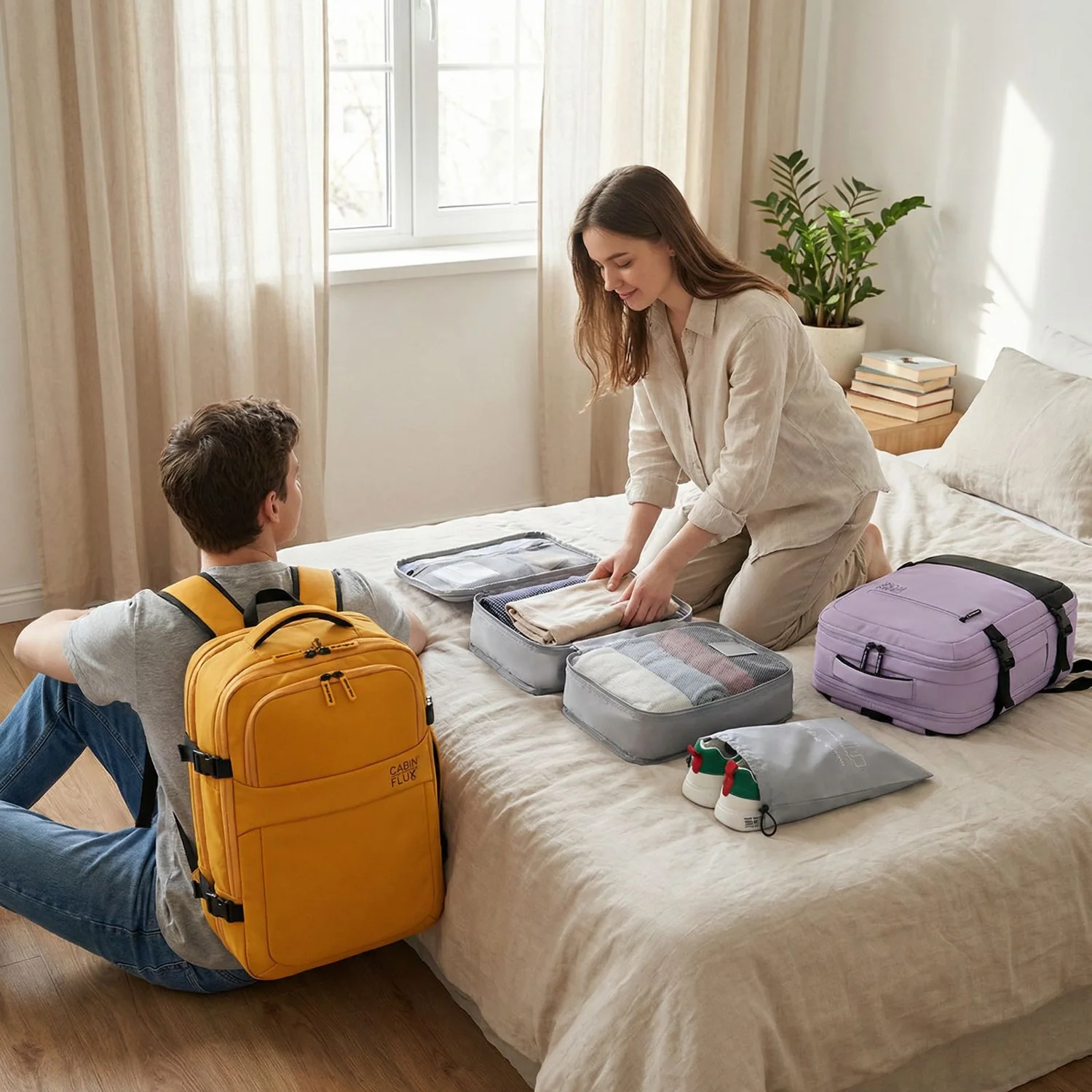
A week away, one cabin bag, no checked luggage, no gate-side repacking. It sounds like a party trick, but it's really just a method — a repeatable system you can run in twenty minutes flat. Here's the exact process we use.
The mistake most people make is packing for the person they might become on the trip: the one who goes to a gala, hikes a glacier, and needs a third pair of shoes "just in case." You pack for possibilities. Instead, pack for the days you'll actually live. Seven days needs far less than seven outfits.
Start with a capsule wardrobe
A capsule is a small set of clothes that all work together. Pick one or two colours that pair with everything — navy, grey, black, cream — and build around them. Every top should go with every bottom. When your clothes mix and match, five pieces become a dozen outfits, and you carry a fraction of the volume.
Choose fabrics that earn their place: merino wool and technical blends breathe, resist odour, and dry overnight in a hotel sink. Cotton is comfortable but bulky and slow to dry. One quiet upgrade in fabric saves you three garments in the bag.
The 1-2-3-4-5-6 rule
This is the backbone. For a week of travel, pack:
- 1 hat or packable layer (and one pair of sunglasses)
- 2 pairs of shoes — one worn, one packed
- 3 bottoms — trousers, shorts, or a skirt
- 4 tops that all pair with those bottoms
- 5 pairs of socks
- 6 pairs of underwear
Adjust to your climate — swap a bottom for a swimsuit, a top for a warmer mid-layer — but keep the ratios. It's enough for a week with one quick laundry rinse, and it fits a cabin bag every time. (Not sure your bag qualifies as one? See the cabin bag size rules, decoded.)
Pack for the days you'll actually live, not the person you might become on the trip.
Rolling vs folding — use both
The eternal debate has a boring answer: it depends on the garment. Roll soft, casual items — t-shirts, jeans, knitwear, activewear. Rolling compresses them tightly and, done well, produces fewer creases than a flat fold. Fold structured or crease-prone pieces — dress shirts, blazers, tailored trousers — and lay them flat across the top so the fold lines fall naturally.
The real space win, though, isn't the technique. It's the container.
Packing cubes: the actual system
Packing cubes turn a chaotic bag into a filing cabinet. They don't shrink your clothes, but they compress and organise them so every inch is used — and unpacking becomes lifting three tidy blocks out instead of excavating.
- One cube per category — tops in one, bottoms in another, underwear and socks in a small one.
- Compression cubes for bulk — a zip-down compression cube can claw back a third of the volume from jumpers and jackets.
- Colour-code or label so you find things without unpacking the whole bag.
Cubes also make a carry-on trip sustainable: at the destination you drop the cubes straight into a drawer and live out of them, then reload in reverse on the way home.
Toiletries within the liquid limits
Cabin rules cap liquids at containers of 100 ml or less, all fitting inside one transparent, resealable bag of roughly one litre. Work within it rather than against it:
- Decant into small refillable bottles instead of carrying full-size products.
- Go solid where you can — shampoo bars, solid deodorant, and toothpaste tablets don't count as liquids at all.
- Keep the bag at the top of your carry-on so it's out and back in three seconds at security.
Wear your bulk, balance your weight
Your heaviest items should never be inside the bag. Wear your bulkiest jacket and your heaviest shoes onto the plane — a puffer and a pair of boots can be a kilogram you're not fighting the scale over. Stuff pockets with the small heavy things: charger, power bank, keys. The other easy kilogram lives in the case itself — here's why an ultralight shell wins.
Inside the case, distribute weight deliberately. In a wheeled carry-on, pack the heaviest items — shoes, toiletry bag — down by the wheels and spine so the case stays balanced and rolls upright. In a cabin backpack, keep weight close to your back and centred between your shoulder blades, not sagging at the bottom.
The twenty-minute run-through
Lay out the capsule. Run the 1-2-3-4-5-6 list. Roll the soft stuff into cubes, fold the sharp stuff on top, clip the liquids bag at the very top, and wear the heavy layer. That's it — a week, one bag, no drama.
Do this two or three times and it stops being a checklist and becomes a habit. You'll walk past the baggage carousel, straight to the exit, every single time.