
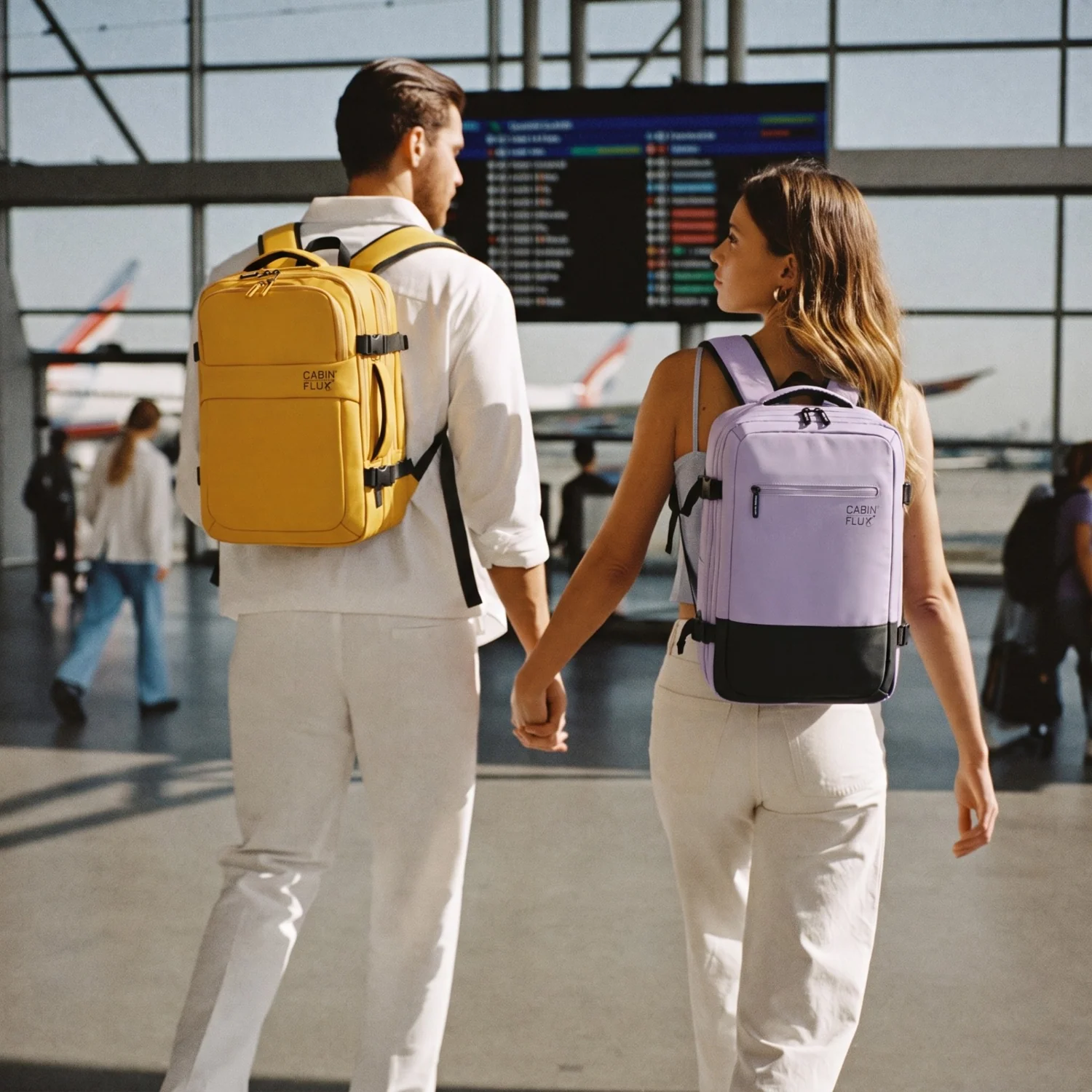
There is no universal cabin bag size. That single fact is behind almost every gate-side drama you've ever watched — the passenger whose bag fit last month, on a different airline, being told to pay £50 now. Learn the handful of sizes that actually matter and you'll never be that passenger.
Cabin allowances come in two flavours: the small "personal item" that goes under the seat in front of you, and the larger bag that goes in the overhead bin. Some fares include both. Many budget fares include only the under-seat bag — and that's where people get caught. Here's how the numbers break down.
The two sizes that rule everything
40 × 30 × 20 cm — the strict under-seat bag
This is the tough one. On Ryanair, Wizz Air and similar low-cost carriers, the free bag you get with a basic fare must fit 40 × 30 × 20 cm and slide under the seat. It's small — roughly a large backpack — and the sizers at the gate are unforgiving. If your bag bulges past the frame, it doesn't fit, full stop.
55 × 40 × 20 cm — the overhead carry-on
This is the "normal" carry-on most people picture: the wheeled cabin case in the overhead locker. A common standard is 55 × 40 × 20 cm (some airlines allow 23 or 25 cm of depth). It's included on many full-service fares, or bought as an add-on on budget ones. A bag built to 55 × 40 × 20 fits the widest range of airlines.
| Bag type | Typical size | Goes | Typical weight cap |
|---|---|---|---|
| Under-seat | 40 × 30 × 20 cm | Under the seat | 10 kg |
| Small overhead | 45 × 36 × 20 cm | Overhead bin | 7–10 kg |
| Standard carry-on | 55 × 40 × 20 cm | Overhead bin | 7–10 kg |
Always confirm on your specific airline's website before you fly — a centimetre or a kilo either way is exactly what the gate staff are trained to catch. The exact dimensions of every CABIN FLUX bag are listed on its product page and in our FAQ.
Don't forget the weight limit
Fitting the sizer isn't enough. Most carriers pair the dimensions with a weight cap, commonly 7 to 10 kg for a cabin bag. A case that slides into the frame perfectly can still be flagged if it tips the scale. This is exactly why the empty weight of your bag matters — start with a light shell and you keep more of the allowance for what's inside.
The wheels and handle count. Airlines measure the whole bag, protruding parts and all — not just the main body.
How to never pay a gate fee again
- Measure the whole bag. Include wheels, handles and any external pockets. The published size is the maximum for the entire object.
- Don't over-stuff. A soft bag packed past its shape won't fit the sizer even if its flat dimensions are legal. Leave it able to close cleanly.
- Know your fare. Check whether your ticket includes an overhead bag or only the under-seat one — before you get to the airport, not at the gate.
- Weigh at home. A cheap luggage scale costs less than one gate fee and settles the argument in your kitchen.
- Buy for the strictest airline you fly. If a bag fits 40 × 30 × 20, it fits everywhere. Own the small one and you're never surprised.
Which CABIN FLUX bags fit which airlines
We build to these numbers deliberately, so you can match a bag to how you fly:
- Flying budget (Ryanair, Wizz)? Choose a full-opening cabin backpack sized to the 40 × 30 × 20 under-seat rule — it travels free on a basic fare and swallows a surprising amount.
- Flying full-service, or paying for the bin? A Spirit C-Lite carry-on built to the 55 × 40 × 20 overhead standard fits the widest range of carriers — and at 1.9 kg it leaves you room under the weight cap.
- Mixing airlines on one trip? Pair a small under-seat bag with a standard carry-on and you're covered whatever the fare allows.
The two numbers to memorise
40 × 30 × 20 for the strict under-seat bag, 55 × 40 × 20 for the overhead carry-on — both under the weight cap. Fit those, measure the wheels, and the gate sizer stops being a threat.
Cabin rules feel like a trap only because they're inconsistent. Once you know the two sizes that matter and pack to the stricter one, you walk past the sizer without a second glance — every airline, every fare. And once the bag fits, getting a week inside it is the easy part.